
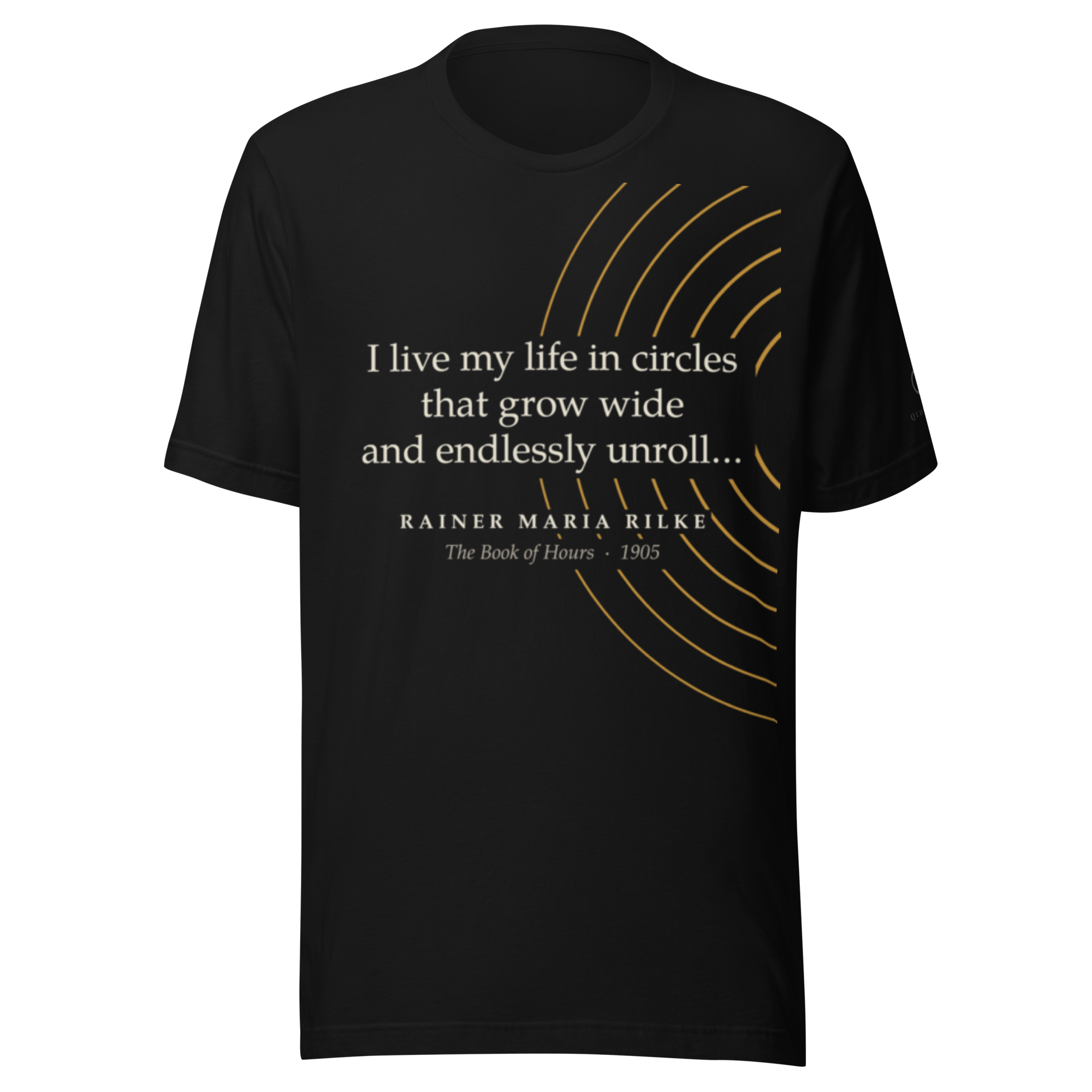

Life in Circles — Rilke Book of Hours T-Shirt
"I live my life in circles that grow wide and endlessly unroll."
Rainer Maria Rilke, The Book of Hours (1905, tr. Jessie Lemont, 1918)
Das Stunden-Buch — The Book of Hours — is a cycle of prayer-poems in the voice of a monk, written in three parts between 1899 and 1903 after Rilke's travels in Russia. This line opens it. The image is expansion, not loss: a life that grows outward rather than closing in — not toward a destination, simply onward.
You're not the person who needs the path to be straight before you'll walk it. Circles growing wide isn't being lost — it's expanding.
The Design
Concentric arcs sweep across the shirt — not a complete circle, but the suggestion of one in motion, expanding past the edges of the fabric. The quote runs through the center of that motion.
The arcs are warm burnished against the black — the same tone as found metal or aged brass, nothing shiny about them.
About This Tee
- 100% combed and ring-spun cotton
- Fabric weight: 4.2 oz/yd²
- Retail fit, true to size
- Side-seamed construction
- Machine washable, cold water
- Quoteiac logo on the left sleeve
Who It's For
The person who reads poetry not to escape but to locate themselves. The one who has lived enough circles to recognize the pattern. Anyone who finds more truth in motion than in arrival.
Wear the orbit.
More in this set: Life in Circles Organic Tee and Life in Circles Phone Case.
Rainer Maria Rilke, in Plain English
- Lived 1875–1926, born in Prague, wrote in German
- The Book of Hours (Das Stunden-Buch) is a cycle of prayer-poems in the voice of a monk, written in three parts — 1899, 1901, and 1903
- Russia was the turning point: two trips (1899–1900), a meeting with Tolstoy, and the Orthodox spirituality he saw there opened his serious work
- The translation here is Jessie Lemont's 1918 version — the earliest English rendering of the book, and the one in the public domain
Choose options