
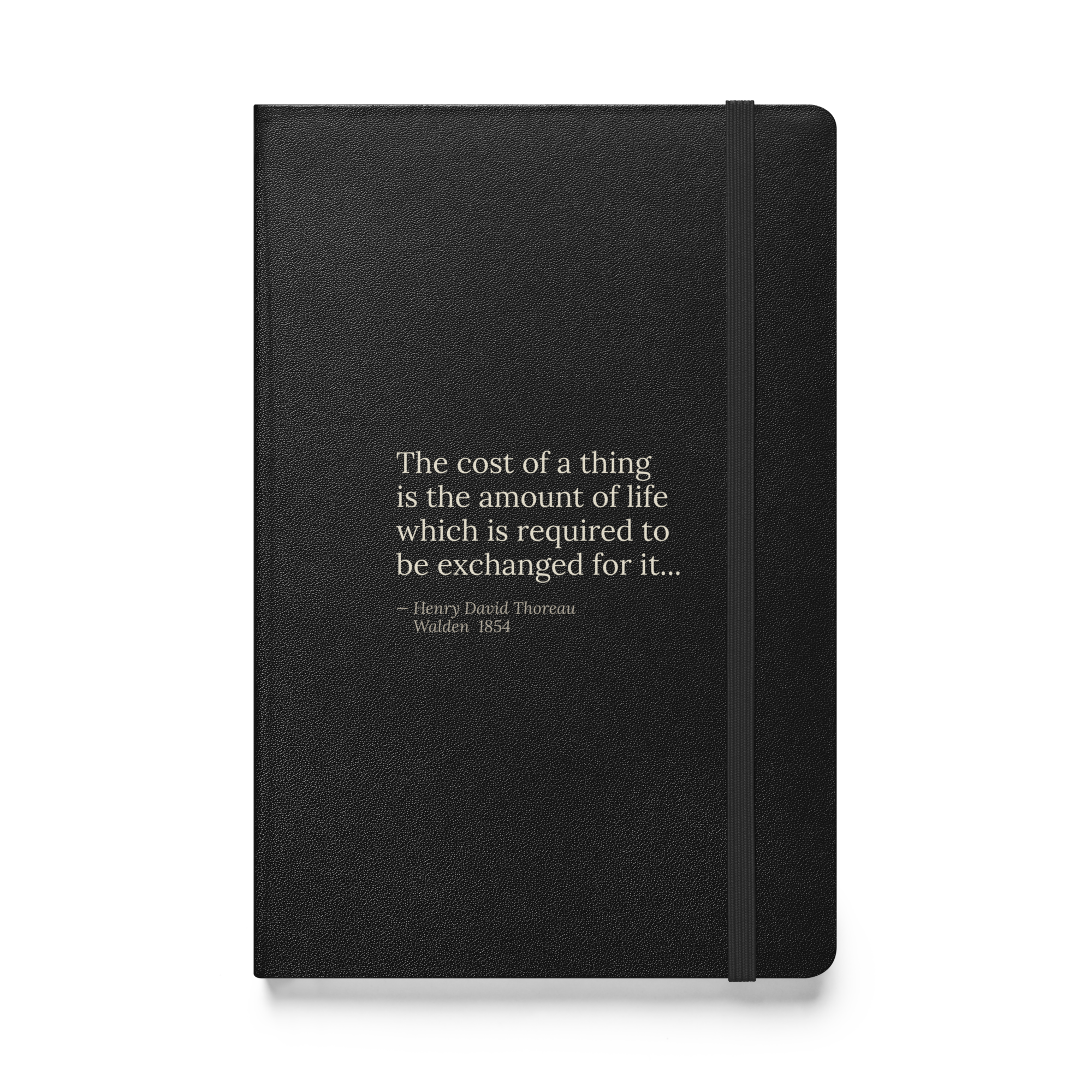


Cost of Living — Thoreau Walden Journal
A journal built for the arithmetic Thoreau actually cared about — not money, but what you give your life to get it.
A literary journal featuring Henry David Thoreau’s “The cost of a thing is the amount of life which is required to be exchanged for it…” from Walden. Literary objects by Quoteiac.
Henry David Thoreau
"The cost of a thing is the amount of life which is required to be exchanged for it…"
Thoreau kept meticulous journals — 14 volumes, nearly two million words over his lifetime. He wrote in them daily, tracking observations, costs, ideas, the exact depth of Walden Pond on different days. The journals weren't a record of what he thought. They were where he figured out what he thought. Walden was distilled from them over nearly a decade of revision.
The quote on the cover is from "Economy" — his audit of what things actually cost in units of life. Writing is its own version of that audit. You find out what something is worth to you by how much of yourself you're willing to spend working it out on the page.
Read the full story behind this quote: The Soul Becomes Dyed: What Marcus Aurelius and Thoreau Actually Said.
Also in the Henry David Thoreau collection: Cost of Living Tee, AWAKE. Tee, Touchstones Tee, and Touchstones Mug. Browse the full Thoreau collection.
The Design
The quote runs as a single block of text — four lines, no hierarchy, no ornaments. The ellipsis at the end is Thoreau's: he was writing about the economics of attention, and the sentence trails open on purpose. Attribution sits smaller below. The cover is the argument: how much life does this journal cost you, and is it worth it?
About This Journal
- Hardcover bound journal
- 80 lined, cream-colored pages
- Size: 5.5" × 8.5"
- Built-in elastic closure
- Ribbon page marker
- Expandable inner pocket
Who It's For
The one who works things out by writing them down. The person who journals because thinking on the page is more honest than thinking in their head. Anyone who understands that the act of writing is itself a form of accounting — for time, for attention, for what matters.
Write what it's worth.
Henry David Thoreau, in Plain English
- Lived: 1817–1862, Concord, Massachusetts
- Spent two years and two months in a self-built cabin at Walden Pond — then spent the rest of his life writing about what he learned there
- Walden's opening chapter, "Economy," is a detailed audit of what things actually cost in units of life exchanged — one of the most precise pieces of American prose ever written
- Died at 44 of tuberculosis; his last documented words were "moose" and "Indians," which is exactly on brand

Choose options