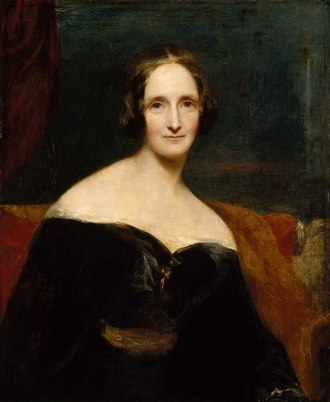
Mary Shelley
In the summer of 1816, a group gathered at the Villa Diodati on Lake Geneva — the poet Byron, his physician John Polidori, Percy Bysshe Shelley, and an eighteen-year-old named Mary Godwin who would publish under the name Mary Shelley two years later. The summer was unnaturally cold and dark: the volcanic eruption of Mount Tambora the previous year had thrown enough ash into the atmosphere to cause crop failures across the Northern Hemisphere. Byron proposed a ghost-story competition. The story Mary Godwin began that summer became Frankenstein.
- Born: August 30, 1797, London
- Died: February 1, 1851, London (age 53, brain tumor)
- Era: Romanticism; Gothic fiction; proto-science fiction
- Major works: Frankenstein, or The Modern Prometheus (1818, published anonymously; 1823, second edition under her name), The Last Man (1826), Valperga (1823)
- Daughter of philosopher William Godwin and feminist Mary Wollstonecraft, who died eleven days after Mary's birth
She had already lost a premature baby the year before the Villa Diodati summer. Percy wrote the preface to the first edition of Frankenstein, and most readers assumed he had written the novel. She revealed her authorship in the second edition of 1823. She was twenty when the first edition published. The question the novel asked — what do we owe to the things and people we bring into being? — was not abstract for a woman who had watched a baby die and was living in a world that didn't know what to do with her intelligence.
Frankenstein was never just a horror story. It was an argument about creation and responsibility, built around a creator who generates life and then refuses to be accountable for what that life becomes. The creature is not the villain of the novel. The abandonment is. This is the reading that has made the book continuously relevant: every era finds its own version of what is being created and abandoned.
She kept writing after Percy drowned in a storm off the Italian coast in 1822. Through his death, through the deaths of three of her four children, through financial hardship and social marginalization, she wrote novels, biography, travel writing, and essays. She was her mother's daughter in this: Mary Wollstonecraft had argued that women's minds were as serious as men's. Mary Shelley proved it by continuing to use hers under conditions that would have ended most careers.
For the readers of gothic fiction, science fiction, feminist literature, and anyone who believes that the most important questions don't have comfortable answers.
Filters