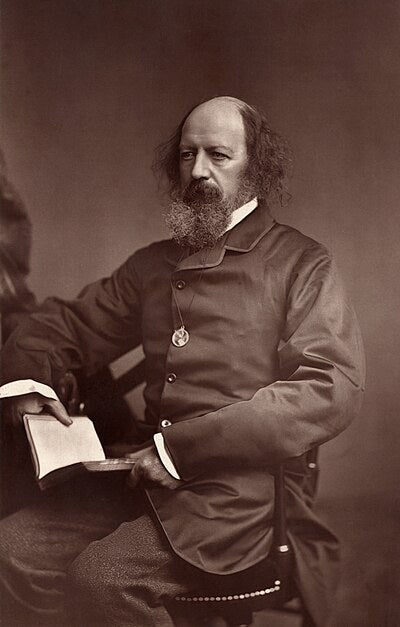
Alfred, Lord Tennyson. Photograph, c. 1869.Public domain.
Alfred, Lord Tennyson
He grew up in a rectory in Lincolnshire and spent his life writing toward something he couldn’t fully name — grief, ambition, the strange persistence of experience. The line on this product is from a poem he wrote in three weeks and spent the rest of his life unable to surpass.
Words We Carry
Every quote here is traced to a documented source. How we verify →
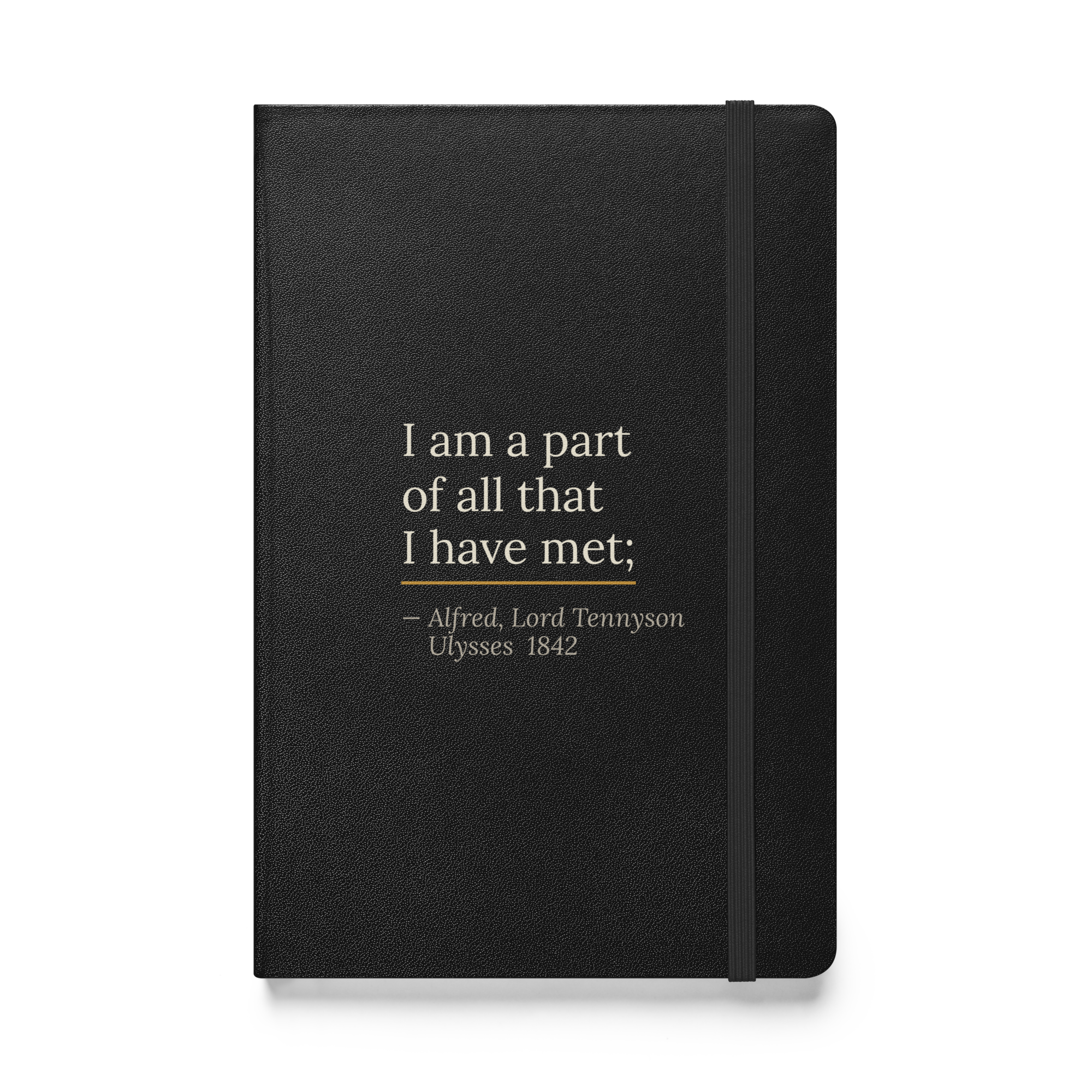
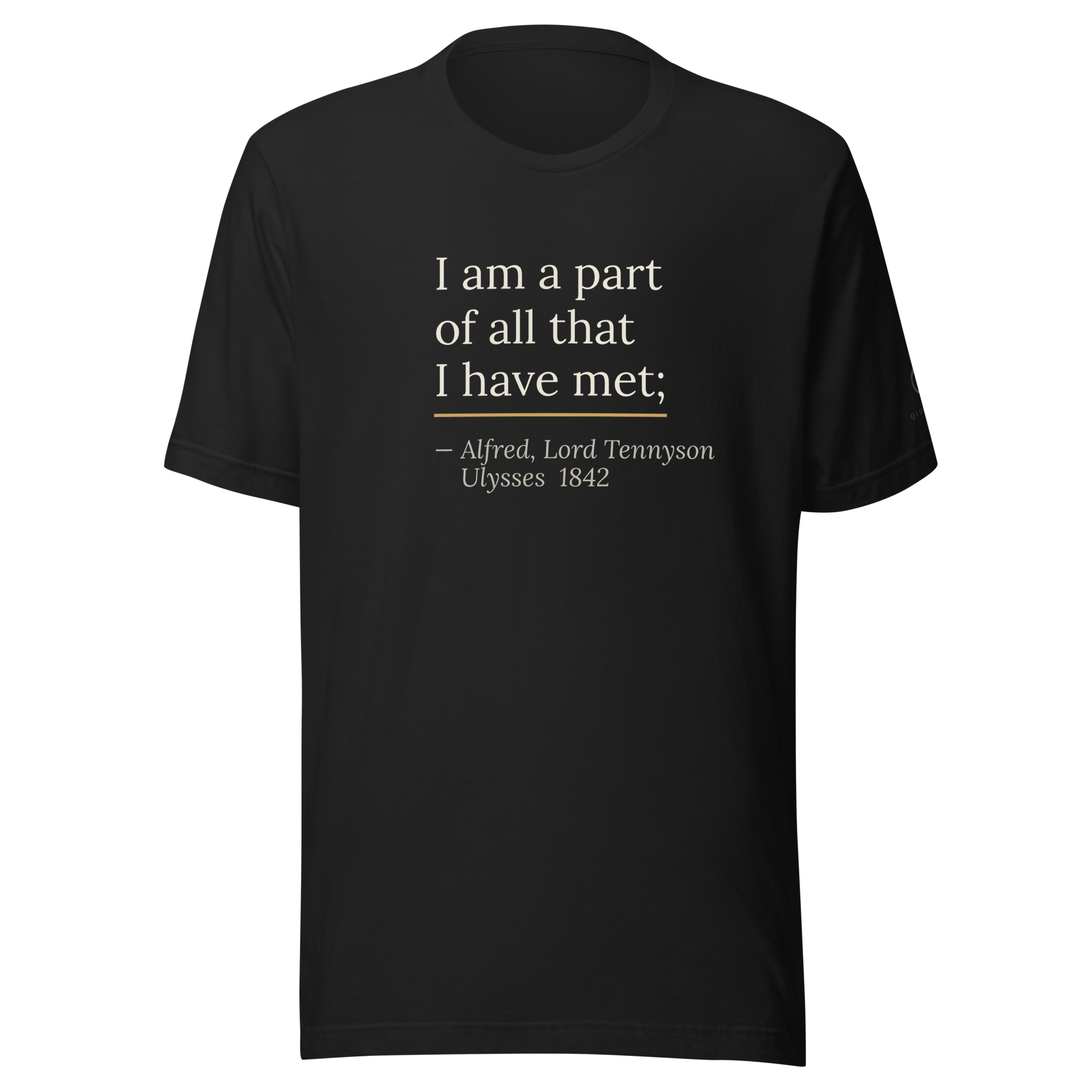
“I am a part of all that I have met;”
Alfred, Lord Tennyson, “Ulysses” (written 1833; published in Poems, 1842)
About Alfred, Lord Tennyson
Alfred Tennyson was born in 1809 in Somersby, Lincolnshire — the fourth of twelve children in a household held together by a rector father prone to severe depression, debt, and periodic breakdown. It was not a stable ground to grow up on. Tennyson started writing early, partly because the house gave him reason to disappear into language. At eighteen he went up to Trinity College, Cambridge, where he encountered the kind of intellectual companionship he’d never had at home. He joined a debating society called the Cambridge Apostles — serious, argumentative young men who read everything — and there he met Arthur Hallam. Hallam was two years younger, brilliantly quick, and became Tennyson’s closest friend in the way that happens once: entirely, and with no preparation for what it costs when it ends. They were inseparable at Cambridge. Tennyson won the Chancellor’s Medal for poetry in 1829. Hallam got engaged to Tennyson’s sister. The future felt like something you could count on.
In September 1833, Arthur Hallam died suddenly in Vienna. He was twenty-two. Tennyson was twenty-four, and within three weeks of hearing the news he had drafted Ulysses — a poem in which an old king refuses to stop moving, refuses to be defined by where he has been rather than where he is going. Tennyson said it expressed “the need of going forward.” He would spend the next seventeen years writing In Memoriam A.H.H., one of the longest elegies in the English language, published in 1850. That same year he was appointed Poet Laureate, a position he held until his death. The appointment shaped his output — Idylls of the King, his Arthurian cycle, ran from 1859 to 1885 and occupied decades of revisions. Then there was “The Charge of the Light Brigade,” written in 1854 in minutes after he read a dispatch in The Times reporting the catastrophic cavalry charge at Balaclava. That one took no years. Just the newspaper, the rage, and the speed of a man who had learned not to wait.
Ulysses opens on an old king who has come home from decades of war and wandering — and cannot stay. His wife, his son, his island: none of it holds him. The line “I am a part of all that I have met” is not a warm sentiment about memory. It is a statement of what happens to you when you have been places and done things: you do not come back unchanged, and you cannot pretend to be the person who left. Every journey revises you. The version of yourself that exists now is made of all of it — the good years, the wasted ones, the grief, the movement. Tennyson wrote this as a young man processing unprocessable loss, and made his speaker an old one who has run out of patience for stillness. That’s the tension that makes the line outlast the poem. On a garment, it is not nostalgia. It is not looking back. It is a declaration of the kind of person who keeps going — shaped by everything, stopped by nothing.
The Work
From the Journal
I Am a Part of All That I Have Met
Tennyson wrote "I Am a Part of All That I Have Met" in grief, weeks after his closest friend died. The poem behind the line.
ReadPercy Shelley: Poetry as Philosophy
The Romantic poet who argued that poetry is the motor of moral imagination — and paid for it.
ReadWhy Dark Romanticism Is Having a Moment Right Now
On the movement that made grief, doubt, and the interior life into serious literary subjects.
ReadIn Their Orbit