The Declaration of Independence Is Great Literature — Here's How It Works
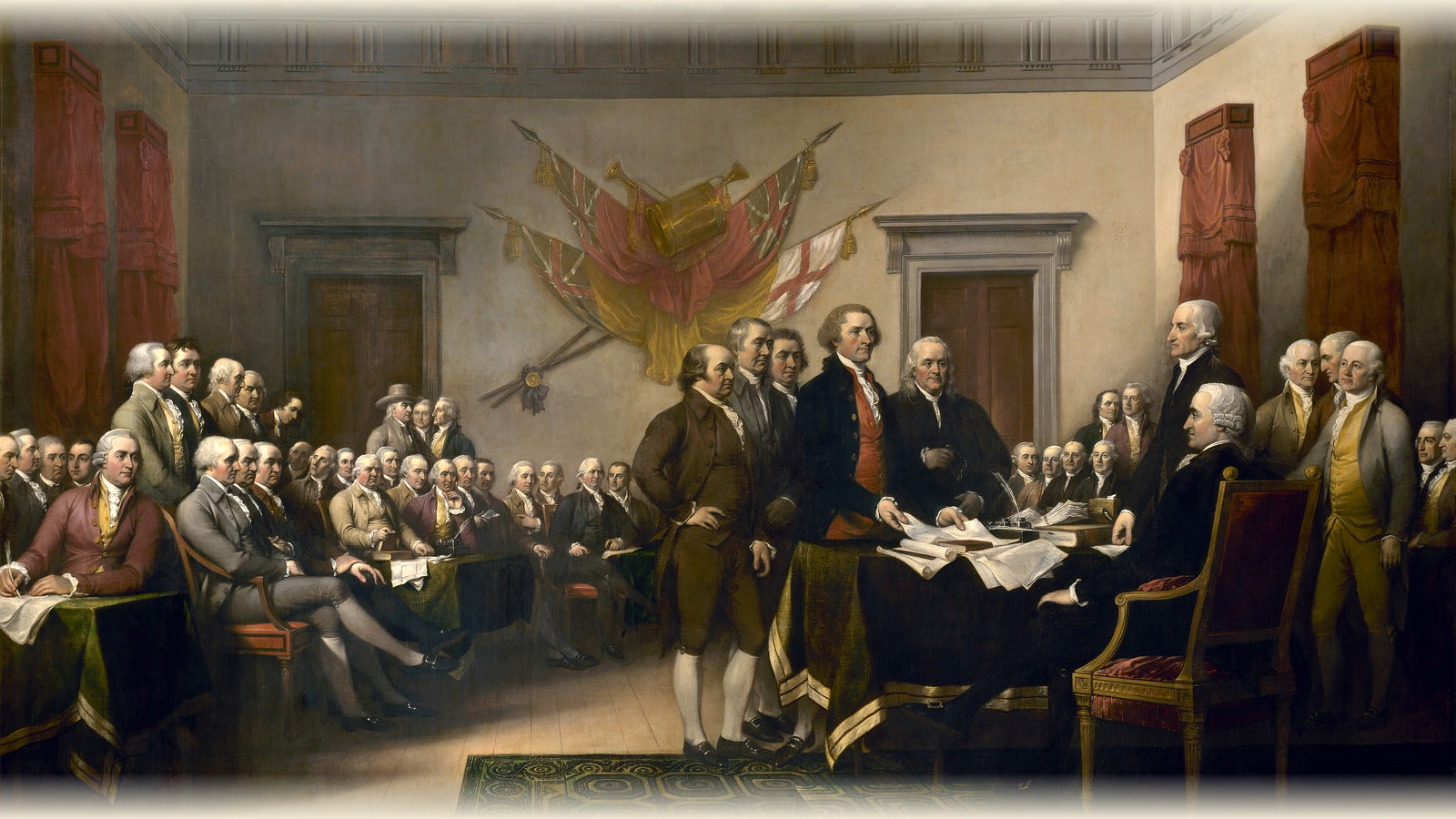
The Declaration of Independence is the most consequential piece of American prose ever written — and it was written to be heard. Jefferson composed the preamble with the cadence of spoken argument, not the syntax of legal drafting. The phrases stack and build the way a preacher's sermon does, or a lawyer's closing statement. “We hold these truths to be self-evident” is not a philosophical claim; it is a rhetorical move. Understanding the difference changes how you read everything that follows.
In this piece:
- Why “self-evident truths” is a rhetorical strategy, not a philosophical argument
- How Jefferson’s preamble works as a syllogism — and why that structure matters
- What the document actually says about equality, and what it deliberately left unresolved
- The specific edits Congress made, and what they tell us about the document’s authorship
Jefferson was thirty-three years old when he drafted the Declaration, working from a rented second-floor room on Market Street in Philadelphia in June 1776. He used John Locke, George Mason’s Virginia Declaration of Rights (drafted just weeks earlier), and his own prior work. He was given seventeen days. The document he produced was then revised by Benjamin Franklin, John Adams, and the full Congress — eighty-six changes in all, some minor, some significant. The version that exists is not the version Jefferson wrote.
“Self-Evident Truths” Is a Rhetorical Stance, Not a Proof
Jefferson’s original draft used the phrase “sacred and undeniable” rather than “self-evident.” Franklin changed it. The shift matters more than it might appear. “Sacred and undeniable” invokes divine authority — these truths are true because God ordained them. “Self-evident” invokes Enlightenment rationalism: these truths require no proof because anyone who reasons clearly will arrive at them. Franklin’s edit moved the document from religious assertion to philosophical claim.
But “self-evident” is also, by its own logic, an assertion that forecloses argument. You do not prove a self-evident truth; you state it, and if the audience agrees, you proceed. Jefferson knew exactly what he was doing. The preamble is not an argument for equality — it is a declaration of it, issued as the premise from which the grievances that follow derive their force. The philosophical weight of the preamble is that it makes the king’s conduct unjustifiable by definition: if the truths are self-evident, no reasonable person can side with tyranny.
The Syllogism Underneath the Eloquence
Strip the preamble to its logical skeleton and you find a classical syllogism. The major premise: governments derive their just powers from the consent of the governed. The minor premise: whenever a government becomes destructive of these ends, the people have the right to alter or abolish it. The conclusion: therefore, the colonies have the right to declare independence. Everything before the list of grievances is setup. Everything in the list is evidence. The final declaration is the verdict.
Jefferson studied classical rhetoric, and the structure shows. The preamble borrows the periodic sentence — where the main clause is withheld until the end, creating suspense and weight. “We hold these truths to be self-evident” opens a series of clauses that accumulate until they land on the conclusion. The reader (or listener — this document was read aloud in public squares and from church pulpits) is carried through a logical chain that arrives, by design, feeling inevitable.
What Jefferson Actually Wrote About Equality
“All men are created equal” is the most quoted and most contested line in the document. Jefferson owned enslaved people — roughly 600 over the course of his life, including 130 at Monticello at the time he wrote these words. The contradiction was not lost on contemporaries. Samuel Johnson, writing in London in 1775, asked: “How is it that we hear the loudest yelps for liberty among the drivers of negroes?”
Jefferson’s draft included a passage condemning the slave trade — blaming King George for perpetuating it — which Congress struck entirely. The deletion was not incidental; it was the price of Southern delegates’ agreement. What remained was a statement of equality so broad that it would take another century and a war to begin making it operative. Lincoln understood this: his Gettysburg Address is, in part, an argument that the Declaration’s premise — not the Constitution’s compromises — is the founding document’s real moral core.
The Eighty-Six Changes
Congress made eighty-six edits to Jefferson’s draft — he found the experience mortifying and sat in silence while they worked, occasionally noting his objections to Franklin, who tried to console him. The most famous Franklin anecdote from this period involves a hatter’s sign: a craftsman who worried that his proposed sign, “John Thompson, Hatter, makes and sells hats for ready money,” would be edited down to nothing by committee. Franklin’s point was that committee revision is often reductive. Jefferson agreed.
The most significant surviving change is Congress’s deletion of the slave trade passage. The most consequential stylistic change is Franklin’s “self-evident.” Other edits tightened syntax and removed what Congress judged as inflammatory language. The document that exists is collaborative — Jefferson’s architecture, Franklin’s most memorable edit, Congress’s final pruning. Attribution in full accuracy requires all three.
Why It Belongs in the Canon
The Declaration is not in American literary history because it is a founding document; it is in literary history because it is good. The preamble is elegant, precise, and built to last — every word placed for maximum rhetorical effect. It is the reason Lincoln could invoke it at Gettysburg without quoting it directly and still be understood. It is the reason “all men are created equal” functions as shorthand for an entire political philosophy in a single clause.
Jefferson, Franklin, and Adams are all in the Quoteiac catalog — not because they are famous, but because their verified words hold up. Jefferson’s I Cannot Live Without Books tee carries a line from an 1815 letter to John Adams, verified against the Papers of Thomas Jefferson. Adams’s Facts Are Stubborn Things tee carries his verified 1770 line from the Boston Massacre defense. Madison’s Knowledge Will Forever Govern tee comes from his 1822 letter to W.T. Barry. Primary sources, every one. The same standard that applies to the Declaration applies to everything in the The Curious Mind collection.