
She Painted Abstract Art Before Kandinsky. The Art World Took 80 Years to Notice.
Hilma af Klint (1862–1944) was a Swedish painter who produced large-scale abstract works between 1906 and 1915 — years before Wassily Kandinsky's Über das Geistige in der Kunst (1911) established his claim to the origin of abstract art. She kept them hidden. When she died, she left instructions that the paintings not be shown for at least twenty years after her death. Her nephew held them for forty-two. The 2018–2019 Guggenheim retrospective that finally made the argument drew 600,000 visitors — the most attended exhibition in the museum's history. The record it broke had been held by a Kandinsky show.
Her nephew kept them in storage for forty-two.
The first public showing came in 1986, at the Los Angeles County Museum of Art, in an exhibition called The Spiritual in Art: Abstract Painting 1890–1985. The art world took note, then largely moved on. It took another thirty-two years and a Guggenheim retrospective to finish the argument.
Hilma af Klint: Paintings for the Future ran from October 2018 to April 2019. It drew approximately 600,000 visitors — the most attended exhibition in the Guggenheim’s history since the museum opened in 1959. The record it broke had been held by a Kandinsky show.
That detail is not accidental.
The question of whether af Klint or Kandinsky made the first abstract paintings in Western art history is one that art historians have been debating seriously since the 1980s, and with increasing urgency since the Guggenheim show. The answer depends partly on what you date and partly on what you accept as evidence.
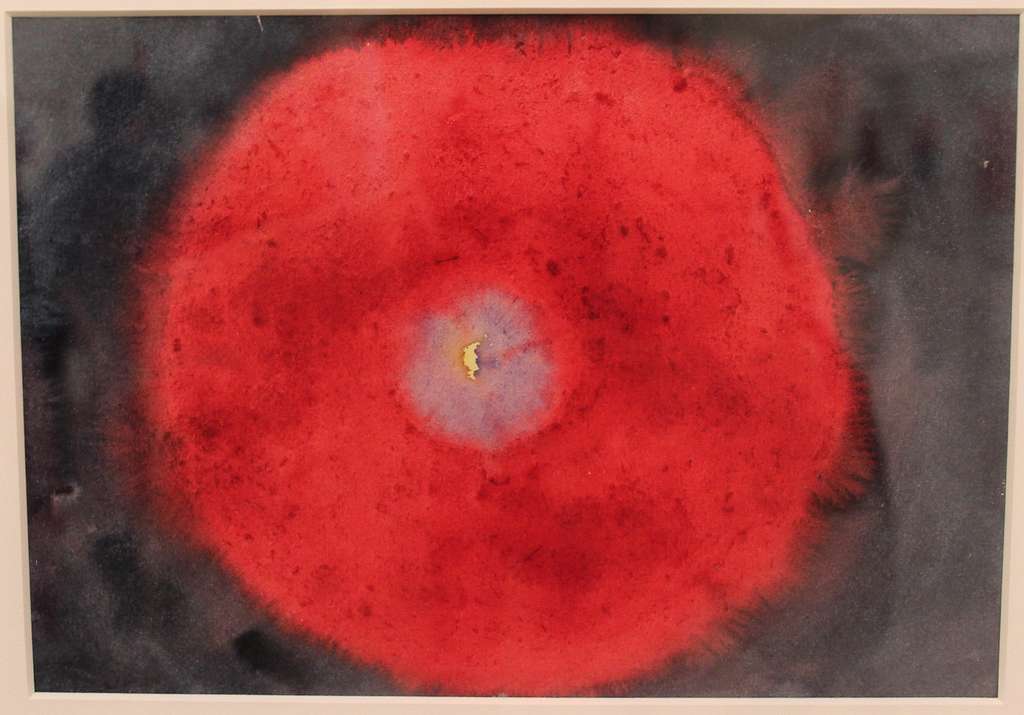
Af Klint began The Paintings for the Temple in autumn 1906. Group IV of the series — The Ten Largest, ten paintings each measuring 315 × 235 centimeters (roughly ten feet four inches by seven feet eight inches) — was completed in 1907. These are not small experiments. They are monumental, non-figurative canvases painted in tempera on paper mounted on canvas, depicting the stages of human life through pure form and color, with no representational imagery of any kind.
Kandinsky’s first undisputed abstract works date to 1911 — his Composition V and related works, shown at the First Exhibition of the Blue Rider group in Munich that December. He published Concerning the Spiritual in Art the same month, though it carries the imprint date of January 1912. His famous “First Abstract Watercolor” is inscribed 1910, but that date has been seriously contested by scholars — a 1966 monograph catalogued it as circa 1913, and it was subsequently re-dated to 1910 by his widow. Even if you accept the earlier date, af Klint’s work precedes it.
The reason Kandinsky got the credit and af Klint did not is not complicated: he published, exhibited, and positioned himself as a theorist of the new painting. She did none of those things. She painted in private, in Stockholm, outside the mainstream European art networks, and then locked the work away. By the time the twentieth century finished writing its history of abstraction, the story had already been told without her.
What makes af Klint’s situation different from ordinary historical omission is the depth of the archive she left behind. More than 26,000 pages of notebooks — held by the Hilma af Klint Foundation in Stockholm — document her thinking, her spiritual framework, and her intentions for the work in extraordinary detail. She wrote about the paintings as a vehicle for representing the eternal aspects of existence: birth, life, death, spiritual evolution. She described herself as a medium through whom the work passed rather than an originator in the conventional sense.
“The pictures were painted directly through me,” she wrote, “without any preliminary drawings, and with great force. I had no idea what the paintings were supposed to depict; nevertheless I worked swiftly and surely, without changing a single brush stroke.”
This presents an interesting interpretive problem. The spiritual framework she worked within — influenced by Theosophy, by the writings of Helena Blavatsky and Annie Besant, and later by Rudolf Steiner’s Anthroposophy — is easy to dismiss or condescend to. She met Steiner at least twice: in Stockholm in 1908, and at his Goetheanum center in Dornach, Switzerland, in 1920, where she showed him The Paintings for the Temple. What he said in response is known only through her own notebooks. The commonly repeated claim that he told her the world was “not ready” for the work is secondhand at best.
But here is what the spiritual framework shouldn’t obscure: the work itself is formally extraordinary, independent of any belief system you bring to it. The scale, the color relationships, the willingness to commit to pure abstraction at a moment when that wasn’t yet a recognized category of art — these are not accidents of mediumship. They are decisions. The notebooks document a systematic approach to color, form, and composition that runs alongside the spiritual content, not instead of it.
The Guggenheim’s attendance record is the market’s verdict on what the art history books missed. Six hundred thousand people went to see the work of a woman who painted in private, hid the results, died, and waited eighty years for the argument to catch up.
The lesson for anyone who makes things and cares about whether those things last: the work is the record. The archive is the argument. The timeline is longer than any single career.
The Heretics collection at Quoteiac is named for exactly this kind of figure — thinkers and makers who worked outside the consensus and turned out to be right. Browse it here.

