Goethe Spent Twenty Years on Color. Newton Thought He Was Wasting His Time.
There’s a color in Quoteiac’s current palette — a coppery gold, warm and rich — that stops people.
Not everyone can say why. It just feels like something. Substantial. Like it belongs somewhere important.
Goethe could have told you precisely why.
The Poet Who Spent Twenty Years on Color
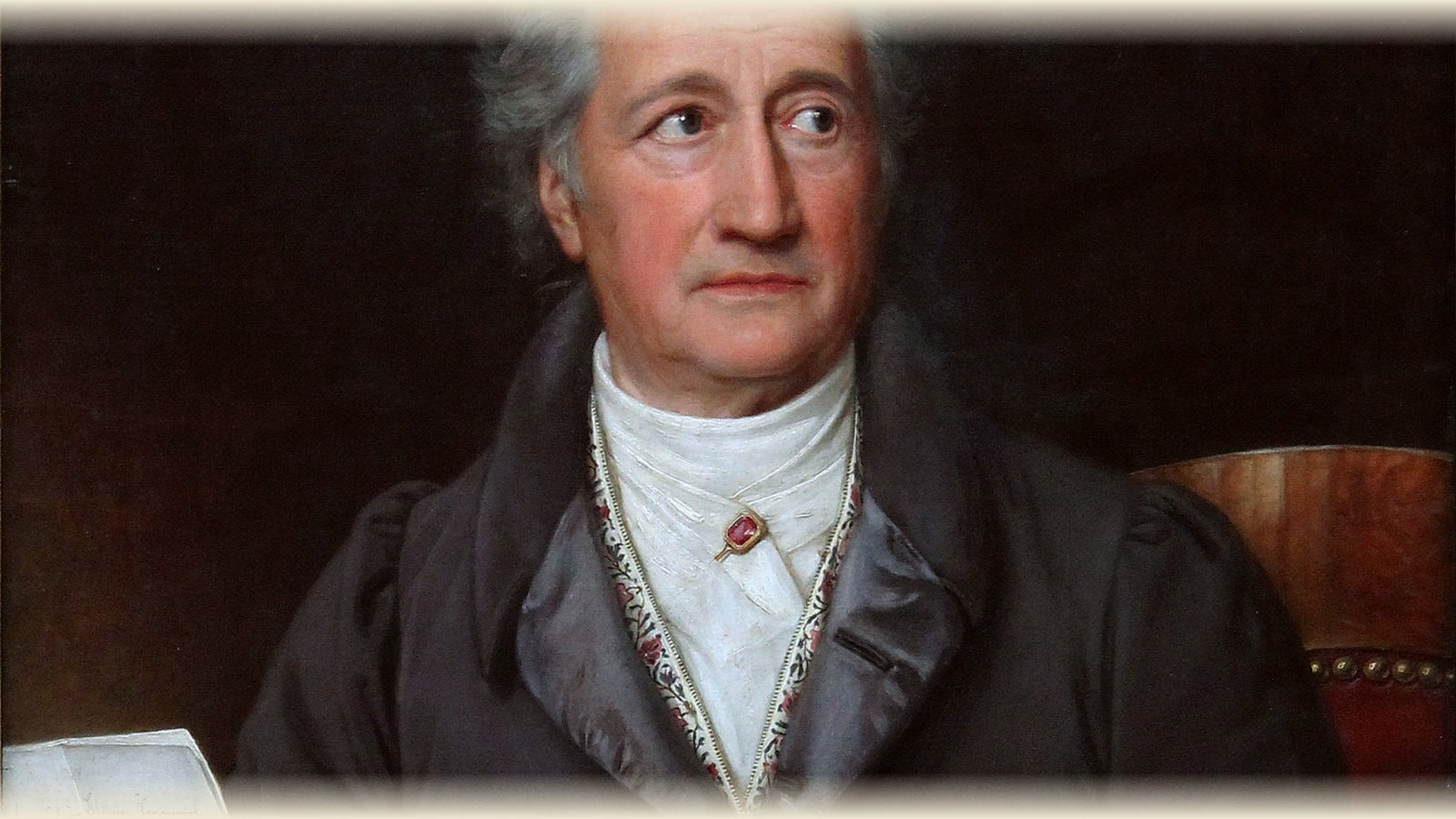
Johann Wolfgang von Goethe wrote Faust — one of the monuments of Western literature — and then spent more of his life studying color than he spent writing poetry.
Not as a hobby. As a vocation he believed was more important than anything else he’d done.
Zur Farbenlehre — Theory of Colours — occupied him for over twenty years. He considered it his greatest work. Isaac Newton’s physics had already “explained” color, and most people thought the matter was settled.
Goethe sat in a dark room with a prism anyway, wrote down what he actually saw, and said Newton had missed the most important part.
What Newton Got Right — and What He Left Out
Newton showed that white light passed through a prism separates into the spectrum. His conclusion: color is a physical property of light. Each wavelength is a color, independent of whoever is watching.
This is correct physics. It remains the foundation of optics. Goethe didn’t dispute it.
What Goethe noticed was that Newton’s method had deliberately excluded one variable: the eye. The person looking.
Color, Goethe argued, doesn’t exist only in the light. It is born at the boundary — where light meets darkness — and it requires a human being to complete it.
“The colours are acts of light; its active and passive modifications.”
Not properties. Acts. Things that happen between the light and the observer.
He was dismissed as a poet playing at science. The physics establishment moved on.
And then, quietly, everyone who worked with color in the following century — painters, designers, educators — kept coming back to Goethe. The Bauhaus color curriculum drew directly on his framework. Josef Albers spent a career documenting exactly the phenomenon Goethe described. Wittgenstein wrote extensive notes on Theory of Colours.
The subjective experience of color — what it does to a person, not just what wavelength it is — turned out to matter.
What He Actually Wrote
Theory of Colours is not what most people expect from a poet’s science book.
It is systematic, dense, and organized by color — yellow, red-yellow, orange, red, blue, green — with Goethe describing the phenomenological effect of each in prose that is precise without being cold. The standard English edition is the Eastlake translation (Charles Lock Eastlake, 1840), now public domain. All the quotes that follow are from that edition.
What he wrote is not metaphor. It’s phenomenological reporting: this is what happens in the eye and the mind when you encounter this hue.
On yellow: “In its highest purity it always carries with it the nature of brightness, and has a serene, gay, softly exciting character.” — §766
Yellow lifts. Goethe describes it as moving toward the eye, arriving with energy. A room painted yellow reads as active before you’ve consciously registered why.
On warm golds and coppers (what Goethe called red-yellow): “The red-yellow gives an impression of warmth and gladness, since it represents the hue of the intenser glow of fire, and of the milder radiance of the setting sun.” — §773
He also wrote specifically about gold: “Gold in its perfectly unmixed state… gives us a new and high idea of this colour.” Not a warm feeling. A high idea. Elevation. That’s the word he chose for the color sitting in Quoteiac’s current palette.
On blue: “As the upper sky and distant mountains appear blue, so a blue surface seems to retire from us. But as we readily follow an agreeable object that flies from us, so we love to contemplate blue, not because it advances to us, but because it draws us after it.” — §780–781
Blue calms because it recedes. You follow it. That’s not decoration — it’s a description of what actually happens when you look at it.
On red: “The effect of this colour is as peculiar as its nature. It conveys an impression of gravity and dignity, and at the same time of grace and attractiveness.” — §796
Red energizes by doing something unusual: it carries weight and magnetism at the same time. Goethe noted it was the color of rulers and the church — not because of tradition, but because of what it does to the eye.
The Quote About Amazement
On February 18, 1829, Goethe said something to his friend and secretary Johann Peter Eckermann that didn’t make it into any of his books.
Eckermann wrote it down anyway, and it became one of the most circulated things Goethe ever said.
“The highest which man can attain in these matters is astonishment; if the primary phenomenon causes this, let him be satisfied; more it cannot bring; and he should forbear to seek for anything further behind it: here is the limit.”
— Conversations with Eckermann, February 18, 1829 (Oxenford translation, 1850). German original: Das Höchste, wozu der Mensch gelangen kann, ist das Erstaunen.
You’ve probably seen the cleaned-up version: “The highest goal that man can achieve is amazement.” That’s a paraphrase — accurate in substance, but it drops the critical context. Goethe is talking about encountering a Uphänomen — a primary, irreducible phenomenon. Something so fundamental that explanation gives way to observation, and the correct response is astonishment rather than further reduction.
He had an image for the opposite: people who peek into a mirror and immediately turn it over to see what’s on the back. That’s the person who can’t accept wonder as the answer. Who needs to get behind the thing rather than simply be in the presence of it.
Goethe thought color was one of those primary phenomena. That’s why he spent twenty years on it and called it more important than Faust. Not because he was eccentric. Because he was being consistent.
The Quote That Isn’t His
There’s a line attributed to Goethe everywhere you look: “Boldness has genius, power, and magic in it.”
It’s not Goethe’s.
Quote Investigator traced it to John Anster’s 1835 loose verse paraphrase of Faust — lines Goethe never wrote — and to W.H. Murray’s 1951 mountaineering memoir, where Murray quoted Anster without attribution. The line circulated under Goethe’s name from there.
The real Goethe is interesting enough without borrowing from someone else’s approximation.
Provenance in Color
Here’s what strikes me about Goethe’s method: he went to the source.
He didn’t accept the prevailing framework. He didn’t trust what he’d been told to see. He sat in the dark, looked through the prism, and wrote down what was actually there — including the things Newton’s theory hadn’t predicted.
That’s the same discipline Quoteiac runs on, applied to words instead of wavelengths. Every quote on every product traces back to a primary source — a manuscript, a first edition, a verified text.
Not “I’ve seen it attributed to Goethe.” The actual words, in the actual document, findable by anyone who wants to check.
What to Do with This
Goethe closed his color theory with a simple instruction that is actually quite hard:
Pay attention to what color does to you. Not what it is. What it does.
Notice what a warm gold feels like against white space — the way it doesn’t just sit there but seems to breathe toward you. Notice what blue does to the back of your mind. Notice what red asks of a room.
You don’t need the theory. You just need to slow down enough to actually look.
The Heretics collection carries writers and thinkers who looked past the accepted answer and wrote down what they actually found. The Dark Romanticism collection carries the ones who insisted that what happens inside the observer matters as much as what’s out in the world.
Both exist because words, like colors, do something. And it’s worth being precise about what, and why, and whose.
About the Author
Vickie MacFadden is the founder of Quoteiac. She adores color and uses it both in her home and in her abstract paintings. She’s the one who will tell you: pay attention to what color does to you."
Related reading: Frankenthaler and color field painting, 1952.