
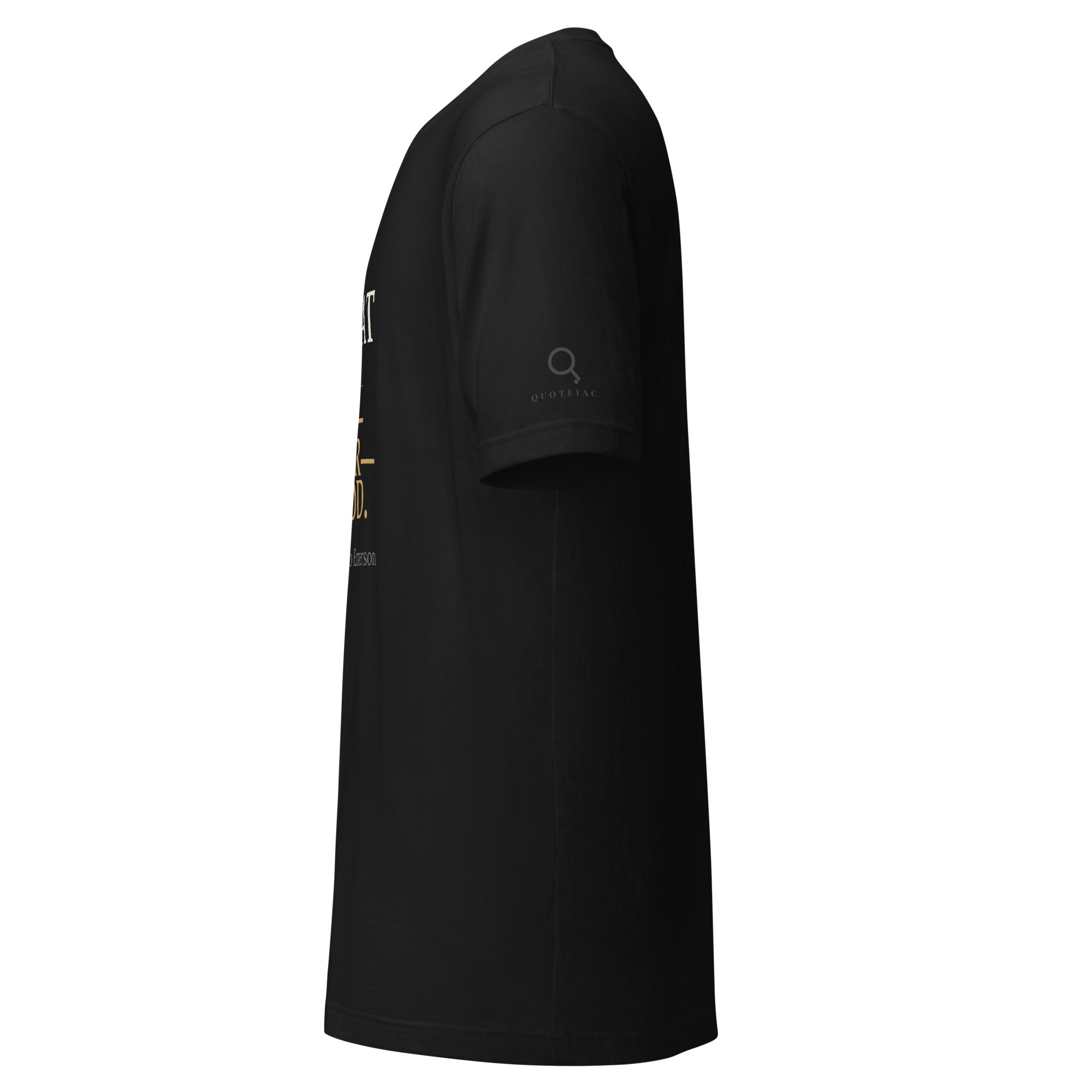

The Misunderstood Tee
Ralph Waldo Emerson
"To be great is to be misunderstood."
Five words from Self-Reliance, 1841. Emerson's essay is a long argument for trusting your own mind over the crowd's verdict — and this line is its sharpest edge.
He wasn't consoling the misunderstood. He was pointing out that misunderstanding is often the price of thinking ahead of the room. Consistency is easy to follow. Originality isn't.
What Emerson Was Really Saying
In Self-Reliance, Emerson lists the company this line keeps: Pythagoras, Socrates, Jesus, Luther, Copernicus, Galileo, Newton. Every one of them was, in their time, misread, dismissed, or actively opposed.
His point wasn't that being misunderstood makes you great. It's that if you're doing something genuinely original — thinking something true that the prevailing consensus hasn't caught up to yet — misunderstanding is almost unavoidable. It comes with the territory.
That's a different thing from wearing rejection as a badge. This line is for the person who has been dismissed for a specific reason: they were right too early.
About This Tee
Soft, lightweight, built for daily wear:
- 100% combed and ring-spun cotton — smooth, close drape
- 4.2 oz lightweight fabric — easy to wear, easy to layer
- Side-seamed construction — holds its shape
- Pre-shrunk — reliable fit wash after wash
- Quoteiac on sleeve
Who It's For
This tee is for the person who stopped needing everyone to get it. Who has had an idea dismissed in a meeting that turned out to be right. Who knows the difference between being contrarian for sport and being genuinely ahead of where things are going.
Not the person who's misunderstood because they're unclear. The one who's misunderstood because they're early.
To be great is to be misunderstood.
More Emerson
If this line speaks to you, Emerson's Leave a Trail Sweatshirt — "Do not go where the path may lead, go instead where there is no path and leave a trail." — comes from the same conviction. Don't follow. Build.
Ralph Waldo Emerson, in Plain English
- Lived: 1803–1882, Concord, Massachusetts
- Essayist, lecturer, and poet — central figure of the American Transcendentalist movement
- Self-Reliance (1841) remains one of the most widely read essays in American literature
- Argued throughout his life that individual conscience and original thought matter more than tradition or social approval
- Mentor to Henry David Thoreau; deeply influenced generations of American writers and thinkers
Size Chart (Bella + Canvas)
| Size | Width (in) | Length (in) |
|---|---|---|
| XS | 16.5 | 27 |
| S | 18 | 28 |
| M | 20 | 29 |
| L | 22 | 30 |
| XL | 24 | 31 |
| 2XL | 26 | 32 |
Choose options

