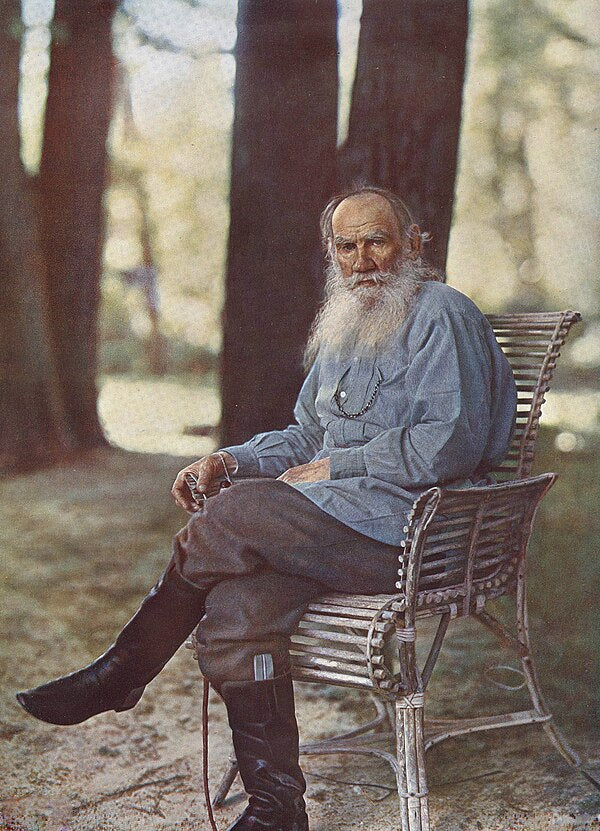
Leo Tolstoy
Leo Tolstoy wrote two of the longest, most encompassing novels in the Western tradition before he turned fifty. War and Peace tracks the lives of five aristocratic families across the Napoleonic Wars and runs to over half a million words. Anna Karenina begins with the most famous opening sentence in Russian literature — “All happy families are alike; each unhappy family is unhappy in its own way” — and proceeds to earn it. He was born into Russian aristocracy, served in the military, ran a school for peasant children on his estate, and was one of the most famous people alive by the time he was forty.
- Born: September 9, 1828, Yasnaya Polyana, Russia
- Died: November 20, 1910, Astapovo (now Lev Tolstoy), Russia (age 82)
- Era: Russian Realism; 19th-century novel
- Major works: War and Peace (1869), Anna Karenina (1878), The Death of Ivan Ilyich (1886), Resurrection (1899)
Then he changed. In the years following Anna Karenina, Tolstoy underwent a spiritual crisis that he documented in A Confession (1882) — a text of such raw self-examination that it reads less like an essay and more like a man arguing with himself in public. He renounced his aristocratic titles, gave away the copyrights to his work, and tried to live by his own moral philosophy: nonviolence, simplicity, direct labor, opposition to state authority and institutional religion.
His later essays on nonviolence — particularly The Kingdom of God Is Within You (1894) — influenced Gandhi directly. Gandhi read Tolstoy in South Africa and later corresponded with him. The chain from Tolstoy to Gandhi to King is documented and direct.
At eighty-two, still trying to close the distance between what he believed and how he lived, he left his home at Yasnaya Polyana in the middle of the night and fled. He made it as far as the small railway station at Astapovo before collapsing with pneumonia. He died there on November 20, 1910, in the stationmaster’s house. His final diary entries, from the days before his flight, are still readable. They show a man who had spent his whole life writing about the right way to live — and was still trying to get there.
For anyone who believes that knowing the right thing and doing it are different problems — and that the struggle between them is worth documenting honestly.