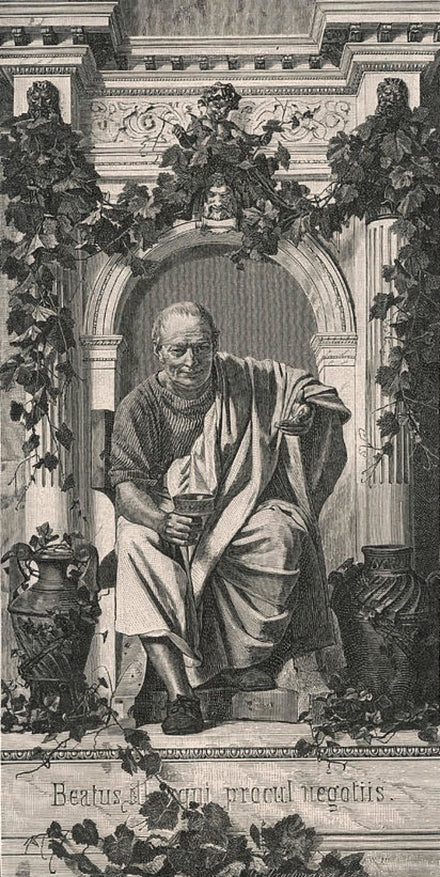
Horace. Engraving after antique bust.Public domain.
Horace
Born a freedman's son in a backwater province, Horace became the most imitated lyric poet Rome ever produced. He wrote the line the Royal Society chose as its founding motto — and the one Kant used to define the Enlightenment.
Words We Carry
Every quote here is traced to a documented source. How we verify →
“Nullius in Verba — Take nobody’s word for it.”
Epistles I.1, line 14 · c. 20 BC. English: the Royal Society’s own reading of its motto.
“Sapere Aude — Dare to Know”
Epistles I.2, line 40 · c. 20 BC. English: our translation, kept close to the Latin.
About Horace
Horace was born in 65 BC in Venusia, a garrison town in southern Italy, to a father who had been a slave. The man was freed before his son’s birth, worked as an auctioneer, and then spent everything he had on Horace’s education — first in Rome, then in Athens, where the sons of senators went to study philosophy. It was an extraordinary act. It also worked. When civil war broke out after Caesar’s assassination, Horace was in Athens and enlisted on the losing side — fighting under Brutus at Philippi in 42 BC. Brutus died. The army collapsed. Horace walked home to find his father’s land confiscated. He got a clerical job in the Roman treasury and started writing.
What came out of that desk job was four books of Odes, two books of Satires, the Epodes, and two books of Epistles — a body of work that transplanted Greek lyric forms into Latin with such precision that later centuries couldn’t tell where Greece ended and Rome began. His patron Maecenas gave him a farm in the Sabine hills, and the farm gave him room to think. Augustus, who had won the civil war Horace had fought on the losing side of, eventually commissioned a fourth book of Odes after a decade of silence. Horace declined the emperor’s offer to serve as his personal secretary. He kept the farm.
He died in 8 BC, two months after Maecenas. Ancient sources record that he had told people he wouldn’t outlive his patron. He was fifty-six. The two lines from the Epistles that outlasted the empire were not written as mottoes or manifestos. They were written as private letters in verse — observations by a man who had fought a losing war, lost his land, found a desk, and thought carefully about what independence actually required. The Royal Society adopted one in 1663. Kant quoted the other in 1784. Neither organization needed to explain what they meant. The lines were already clear.
The Work
From the Journal
Nullius in Verba: What Horace’s Phrase Really Means — and Why We Built a Standard on It
The Royal Society’s motto, traced back to the man who wrote it.
ReadThe Philosophy of Doing Hard Things — From People Who Actually Did Them
On Stoic endurance and what it looks like in practice.
ReadIn Their Orbit