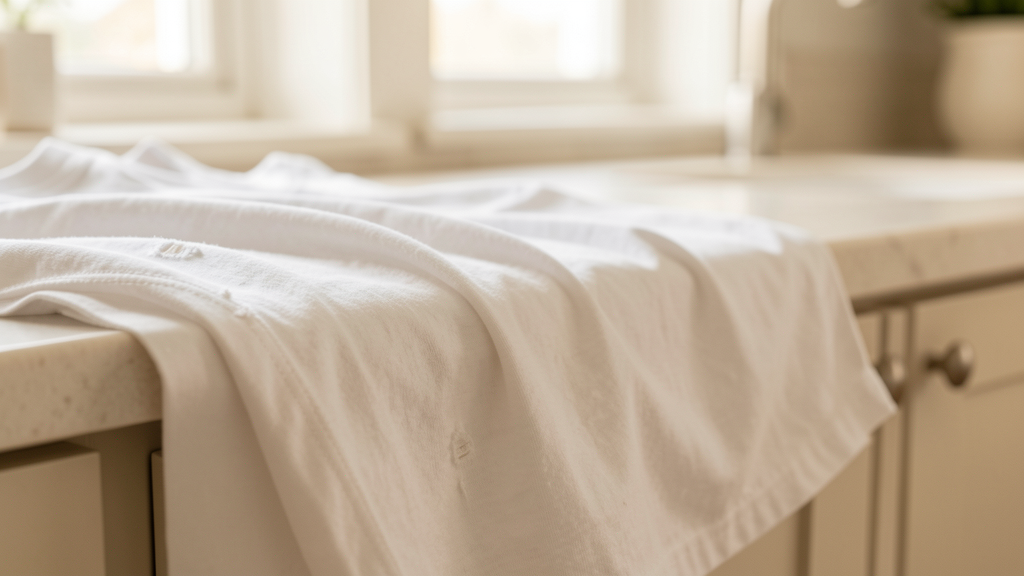
The Case of the Mystery T-Shirt Hole: It's Not Moths, It's Your Kitchen
The small holes that appear near the bottom front of cotton t-shirts — always in the same spot, always on garments worn at home — are caused by friction between the fabric, a hard waistband or belt, and a countertop edge. The mechanism is mechanical abrasion, not insects, detergent, or washing machine damage.
The mystery hole at the bottom of your t-shirt has nothing to do with insects, your washing machine, or a sabotaging spouse. It's geometry.
You've seen them. A small cluster of tiny holes near the bottom front of your favorite t-shirt, slightly off-center, just above the hem. Always in the same place. Always on shirts you wear at home. Never on the work shirts hanging in your closet.
The internet has theories. Moths. Detergent. A torn drum in the washing machine. A vengeful zipper. None of them explain why the holes appear in exactly the same spot, on the same kinds of garments, in the same conditions.
Here is the actual mechanism — and it's a small piece of brutal everyday physics.
The friction sandwich
Look at where the holes sit. Bottom-front, just above the hem, slightly off-center. Now look at where the metal button on your jeans sits when you stand at a counter. Same spot.
Every time you lean against a kitchen counter to wash dishes, chop vegetables, load the dishwasher, or pour coffee, you create a three-layer sandwich:
- Top layer: the stone or quartz countertop. Granite sits around 6–7 on the Mohs hardness scale; quartz is a 7.
- Bottom layer: the metal button on your jeans. Steel runs roughly 4–4.5.
- Filling: the front hem of your t-shirt. Cotton, soft, organic, with no meaningful hardness rating because it's fiber, not stone.
You then press your full body weight into that sandwich and rock against it for the duration of whatever you're cooking. Cotton against metal against rock, thousands of repetitions a year. The fabric fatigues exactly where the geometry pinches it. One wash cycle finishes the job, and the holes appear coming out of the dryer.
This is why the holes cluster:
- Low (at button height)
- Off-center (jean buttons sit slightly to one side of the fly)
- Only on shirts you wear at home
- Never on tucked-in shirts
- Never on dress shirts you wear at the office
You don't lean on countertops in a suit. You lean on them in a soft t-shirt while making dinner.
Why it didn't happen to your mother's t-shirts
Cotton has been cotton for a long time. Granite countertops have been around for a long time. So why is this a relatively recent epidemic?
Because t-shirts got thinner.
A textile chemist at the University of Kentucky has put numbers to what most of us already suspected: a "heavy" t-shirt two decades ago weighed 8 to 10 ounces per square yard of fabric. Today, that's been roughly cut in half. Fast-fashion brands routinely ship 4 to 4.5 oz tees. By minimizing fabric weight, manufacturers also cut what the industry calls "covering power" — how opaque or durable the fabric is. Lighter, softer, faster to fail at the abrasion point.
The friction was always there. The fabric used to be able to take it.
The free fix
You don't need a button cover, a special apron, or a different brand of t-shirt. You need fifteen seconds of behavior change before you walk into the kitchen.
- Tuck the front hem of your shirt behind your jean button. Just the front. The rest can hang.
- Wear an apron when you cook. Not for splash protection — for friction protection.
- If you work at a hard-edged desk, mind the lean. Glass desktops cause the same damage at the same height.
Reports vary, but most people who change this single habit report their shirts lasting three to four times longer.
And about the moths
Moths eat wool primarily. They’re rarely the culprit with plain cotton — and they certainly don’t chew in tidy clusters at the exact height of your jean button, only on the front, only on shirts you wear while cooking. They certainly don't chew in tidy clusters at the exact height of your jean button, only on the front, only on shirts you wear while cooking. The moth theory is a comforting story we tell ourselves because the real answer — that we are slowly grinding our own clothes apart against the kitchen counter — is mildly humiliating.
The honest answer usually is.
A small philosophical kicker, because this is Quoteiac and we can't help ourselves:
There's a quiet lesson in here about how things actually fail. Not dramatically. Not because some malevolent force chewed them in the night. They fail because of small, repeated, unremarkable contact at the exact same point, day after day, that we never noticed we were making.
Worth thinking about. The same logic applies to most things that wear thin in a life. Take care of the cotton, and it'll keep your favorite quotes looking sharp for years to come.
But for now: tuck your shirt behind the button.