The Best Edgar Allan Poe Quotes That Aren't The Raven
Edgar Allan Poe’s most psychologically precise writing isn’t in The Raven—it’s in the short fiction and the lesser-known poems, where he works through questions about perception, grief, and the reliability of the mind that the famous poems only gesture at.
Everyone knows The Raven. These are the lines that reward knowing the rest of his work.
- Poe’s sharpest observations from outside his most-anthologized poems
- The philosophical thread that runs through his fiction and his verse
- Why his best lines hold up as ideas, not just as atmosphere
But Poe's most interesting lines aren't always in his most famous work. They're scattered through the short stories, the essays, the lesser-known poems — places where he wasn't constructing a set piece but just saying the thing directly, with the precision that made him one of the most technically gifted writers in American history.
On Beauty and Darkness
"I have no faith in human perfectibility. I think that human exertion will have no appreciable effect upon humanity. Man is now only more active — not more happy — nor more wise, than he was 6000 years ago."
This is Poe writing privately — in a letter, skeptical, precise, slightly exhausted by human optimism. He was writing in an era of enormous enthusiasm for progress, and he found the whole project unconvincing. Whether you agree or not, it's a bracing antidote to the cheerful inevitability of improvement narratives.
On the Interior Life
"Words have no power to impress the mind without the exquisite horror of their reality."
This is Poe the craftsman speaking — the writer who thought obsessively about how literature produces its effects. He believed that emotional truth required emotional risk. That language only lands when it's reaching for something real, something that actually frightens or moves the writer. Comfort produces nothing worth keeping.
On Love and Loss
"I was never really insane except upon occasions when my heart was touched."
This one is from his letters. Poe's biography is littered with loss — his mother died when he was two, his foster mother when he was twenty, his young wife Virginia from tuberculosis in 1847. He drank too much and too desperately, in ways that ended his life at forty. But his writing about grief and love has a specificity that suggests he wasn't performing sorrow. He was reporting it.
On the Nature of Things
"All that we see or seem is but a dream within a dream."
The title and closing line of one of his shorter poems. It's the kind of line that sounds like a cliché until you actually sit with it — and then it opens into something genuinely unsettling. What is real? What is the difference between waking and dreaming? Poe wasn't being decorative. He was asking the question seriously.
On Writing Itself
"Having conceived, with deliberate care, a certain unique or single effect to be wrought out, he then invents such incidents — he then combines such events as may best aid him in establishing this preconceived effect."
Poe invented the modern short story. Not metaphorically — he wrote one of the first critical essays on the form, outlining the principles that still hold. Unity of effect. Every sentence earning its place. No wasted motion. He was as serious about craft as he was about content, and the combination is why his stories still work.
Why He Lasts
Poe spent most of his life financially desperate, critically underestimated, and emotionally wrecked. He died at forty under circumstances that have never been fully explained. He was famous in his lifetime but not rich, admired in France before he was properly recognized at home. One quote long attributed to him turned out to belong to Washington Irving — we wrote about how that happens.
What he left was a body of work that goes into darkness without flinching and comes back with something true. Not comfortable. Not reassuring. But true — in the way that things are true when someone has looked at them directly instead of looking away. See also: why the Dark Romanticism tradition he helped found is resonating again.
That's the rarest thing in literature. And it's why, more than 175 years later, people are still reading him.
Browse the Edgar Allan Poe collection and Dark Romanticism.
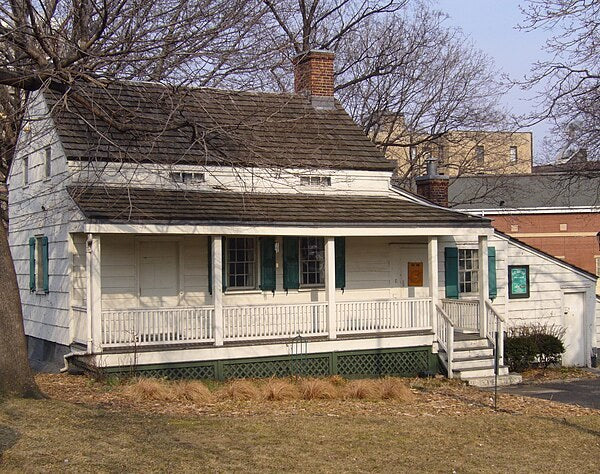
The photograph above is Edgar Allan Poe's actual cottage in the Fordham neighborhood of the Bronx, New York — the last home he ever lived in. He moved there in 1846 hoping the country air would help his wife Virginia, who was dying of tuberculosis. She died there in January 1847. Poe wrote “Annabel Lee” and “The Bells” in this cottage. It still stands today, preserved as the Poe Cottage museum at Poe Park on Grand Concourse. It is one of the few surviving structures directly connected to his life.