Helen Frankenthaler Was Right in 1952. The Art World Took Another Decade.
I adore abstract art, but had never heard of Helen Frankenthaler. Surfing through Facebook marketplace, I came across prints I was drawn to. Arranged to meet the seller, purchased everyone he had. When art speaks to you, it, well, speaks. Then, down the rabbit hole. I needed to learn more about her and why her work drew me in.
In the fall of 1952, a twenty-three-year-old painter named Helen Frankenthaler spread an unprimed canvas flat on the floor of her New York studio and poured thinned paint directly onto it. The paint soaked into the raw cotton. It spread, bloomed, pooled at the edges, left rings where the solvent evaporated. She let it do what it wanted to do. The result was a nine-foot painting called Mountains and Sea, and it solved a problem that the entire Abstract Expressionist movement had been circling without resolving.
The problem was this: if paint is the subject, why is it still sitting on top of the canvas like an object visiting a surface? The great 'Ab Ex' painters—de Kooning, Pollock, Kline—had freed the gesture. They had liberated scale and velocity and accident. What they hadn’t done was free the color itself. It still arrived as pigment sitting on top of ground. Frankenthaler eliminated that gap. When paint soaks into unprimed canvas, it doesn’t sit on the surface. It becomes the surface. Color isn’t applied—it’s absorbed. The canvas doesn’t support the painting. It is the painting.
This is not a minor technical distinction. It is the difference between two fundamentally different ideas about what a painting is.
What Actually Happened Next
In 1953, Morris Louis and Kenneth Noland visited Frankenthaler’s studio and saw Mountains and Sea. Both were established painters. Both immediately understood what she had done. Both went home and rebuilt their entire practice around the soak-stain technique she had invented. Within a few years, their work—large, luminous, color-saturated canvases that seemed to glow from within—was being celebrated as the founding gesture of Color Field painting. Louis and Noland became famous. Frankenthaler’s role as the originating source was frequently noted in footnotes.
She didn’t disappear from the record—that would be too simple a story. She continued to paint, to exhibit, to receive awards. She was included. What she wasn’t, for a long time, was credited in proportion to what she had actually done. The painting that launched an entire movement was available to see, and the dates were not ambiguous, and the mechanism of transmission was documented. The art world largely filed it under influence rather than invention.
This is a pattern with a long history. The person who makes the decisive breakthrough is often not the person who gets to define it. That credit tends to accumulate around those who scale the idea, institutionalize it, give it a name. The originator becomes a precursor. A precursor is a lesser grade than an inventor.
What the Method Was Actually Saying
There is a useful way to think about what Frankenthaler’s soak-stain technique was arguing. She was making the same claim that the best abstract painting always makes: that the medium has its own logic, and the painter’s job is to understand that logic well enough to work with it rather than against it.
Unprimed canvas absorbs. Diluted paint flows. Pooling at edges is not a failure of control—it is information about how the material behaves when you give it room. The paintings that came out of this approach have a quality that’s hard to name exactly: luminous is the word people reach for, but that’s not quite right. They glow because the color is in the surface rather than on it. There is no gap between support and image. The whole thing is one object, not two.
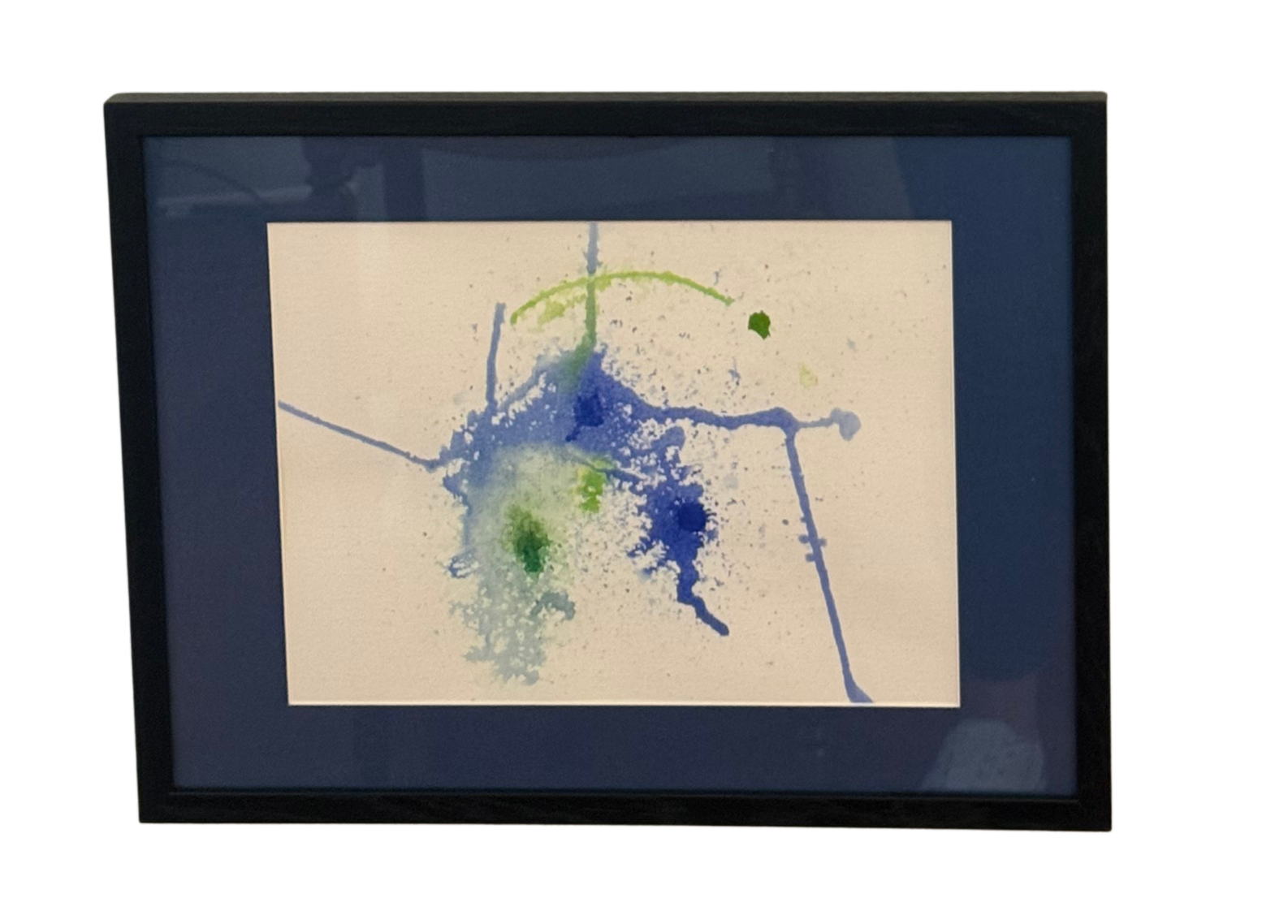
Working with alcohol inks on paper produces something related—not the same technique, and this one surely was not the same scale, but the same underlying negotiation between what you intend and what the material will do. The inks bloom, spread, bleed into each other. A controlled drop explodes into something you couldn’t have planned. The paper itself is part of the composition in a way that a painted surface often isn’t. What you give up in control you gain in aliveness. That is the Frankenthaler insight restated in a different medium: the accident is not the enemy of the painting. It is one of its instruments.
The Delayed Recognition
Frankenthaler’s reputation shifted substantially in the last two decades of her life and in the decade since her death in 2011. Major retrospectives. Serious scholarly attention. The Guggenheim, the Whitney, the MoMA. The record got corrected—not reversed but clarified. The work she made between 1952 and the 1980s is now read for what it was: a sustained body of invention, not a tributary of someone else’s river.
What changed wasn’t the paintings. They were always there. What changed was the institutional willingness to follow the evidence to its actual conclusion rather than to a more convenient one.
This is the thing about being right too early: the work doesn’t stop being right. It waits. The paintings that Frankenthaler made in the 1950s and 1960s were not diminished by the decades in which they were underread. They accumulated. When the attention finally arrived, it had an entire body of evidence to account for.
Why It Belongs Here
Quoteiac’s The Heretics collection exists for exactly this kind of figure: people who understood something clearly before the culture was ready to agree with them, and who kept working anyway. Not martyrs. Not outsiders for outsider’s sake. Thinkers who had a better argument and were patient enough to let it hold.
Frankenthaler had the better argument. The dates confirm it. The influence confirms it. The paintings confirm it. She didn’t need the art world to catch up in order for the work to be what it was. But it is more useful to have the record accurate. For the work, and for everyone who comes after it and needs to know where a thing actually started.
The abstract image above is an original alcohol ink painting on paper from our founder. Alcohol inks on an absorbent surface behave the way Frankenthaler described paint behaving—spreading to their own logic, pooling at edges, leaving marks that record the movement of the fluid rather than the movement of the hand. The similarity is not incidental.
Related reading: Goethe saw color differently — and he was right.